By Ben Macklin
“Someday, in the distant future, our grandchildren’s
grandchildren will develop a new equivalent of our classrooms. They will spend many hours
in front of boxes with fires glowing within. May they have the wisdom to know the
difference between light and knowledge. — Plato
Plato was right on the money. The time he
speaks of is now. The most popular activity conducted by internet users the world over is
researching and accessing information from the internet. The internet is already the
single largest information resource known to man, and it continues to grow every day.
Apart from the potential revenue opportunities associated with e-education, lifelong
learning and the effective distribution of information to a nation’s population are
important social and cultural aims for all countries.
At the aggregate level, US residents spend
approximately $740 billion per year on education and training, according to Merrill Lynch.
Widespread broadband adoption represents a significant opportunity for education, training
and distance learning as it brings remote teachers and students closer together and
provides educational institutions with an opportunity to simulate an actual classroom
environment with a fully interactive multimedia experience. For those at home and those at
work, broadband opens up a greater number of educational and training opportunities that
may not be possible with a dial-up connection.
Online education is a market that is already a
multi-million dollar business in the US. One of the leaders in this market, the University
of Phoenix, has reported it expects revenue in 2002 to total over $280 million.
Merrill Lynch estimates that the e-learning
sector in the US will be worth over $25 billion by 2003. They predict that corporate
learning will generate $11.4 billion of this total.

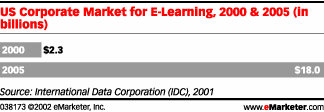
International Data Corp. (IDC) correspondingly forecasts significant growth in the
corporate market for e-learning, rising to $18 billion in 2005 from $2.3 billion in 2000.
Results from a study done by Sage Research indicate that continuing school
education has the potential to be a $3 billion dollar industry. They asked respondents
their willingness to pay $50 per college credit to receive multimedia education from
accredited schools and 14.3% indicated they would pay for this service. Additionally,
respondents indicated their willingness to spend $5 per month for unlimited access to
multimedia encyclopedias, as well as cooking, language and music education.

Education is an investment for the future. If broadband can provide
individuals and organizations with greater access to education, training and learning
resources, then it not only makes sense for a household to invest in broadband, but it
also makes sense for companies, communities and governments to invest in broadband
infrastructure and services. According to the International Telecommunication Union (ITU),
one of the significant reasons why the demand for broadband is so high in South Korea is
not only because South Koreans like to play multi-user games, but that a high-speed
internet connection is regarded as an important family investment.
Ben Macklin is the author of the Benefits
of Broadband Report, released this week. In Part 1, Macklin discussed “The
Costs.” In Part 2, Macklin tackled “Telecommuting.” There are about 900
records in the eMarketer eStat Database for the term “broadband.”
Ben Macklin is a Senior Analyst for
eMarketer and the author of the Interactive TV: Reality & Opportunity Report, North
America Online Report, Telecommunications Spending Report, the North American Wireless
Report and The Broadband Report.
E-mail him at bmacklin@emarketer.com
with comments, suggestions and questions.